
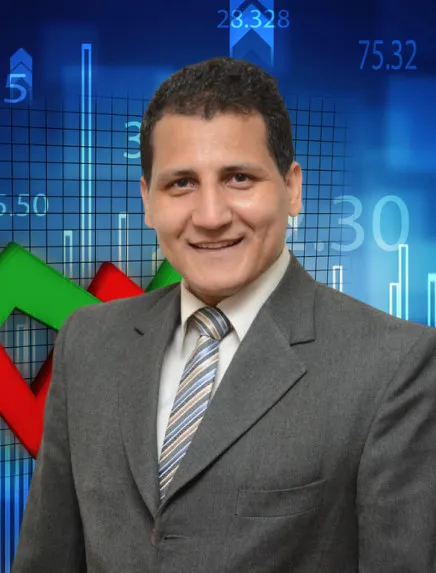
Professor Ali Gamal Abdelgawad: "Gold vs. US Dollar (XAU/USD): A Future Outlook"
Prepared by: Professor Ali Gamal Abdel Gawad – Lecturer of Investment and Finance
The gold/US dollar pair (XAU/USD) is experiencing one of its most active periods this year, reaching $4,908.97 per ounce, a gain of approximately $248.87 or 5.34% in a single session. This surge reflects strong momentum in the precious metals market, driven by a confluence of monetary and geopolitical factors, as well as investment flows towards safe-haven assets. While gold is known for its long-term trending movements, sharp rallies like this often prompt a thorough assessment of technical, financial, and fundamental factors before predicting the next direction.
Technically, gold is trading near the upper limit of its daily range (4,947.75), indicating clear buying dominance in the short term. The positive monthly performance of 13.38%, the quarterly performance of 22.70%, and the semi-annual performance of 46.01% all point to a medium- to long-term uptrend. Conversely, the weekly decline of 5.39% indicates that the market is not immune to rapid corrections. The price remaining above the $4,660–$4,700 range supports the idea that this area has become a pivotal support level. The nearest resistance appears around the daily high of $4,947 and then the psychological barrier of $5,000. A sustained break above these levels could pave the way for a retest of higher highs within the $5,200–$5,600 range in the medium term. Momentum indicators in such rallies typically enter overbought territory, increasing the likelihood of short-term profit-taking even within an uptrend.
Financially, gold's annualized return of approximately 74.5% places it among the best-performing assets recently, attracting investment funds and traders seeking hedging and portfolio diversification. The significant rise in a short period suggests that part of the movement is driven by speculative flows rather than solely long-term investment, which could exacerbate volatility. Furthermore, the wide range between the 52-week low and high (2,806 to 5,595) reflects a market highly sensitive to news and monetary policy, making risk management essential for any trader.
Essentially, gold typically moves in response to three main factors: real interest rates in the US, the strength of the dollar, and the level of global geopolitical and economic risk. Any expectations of an economic slowdown or central bank easing tend to support gold, as it is a non-yielding asset that benefits from low real returns. Additionally, increased central bank gold purchases in recent years have boosted structural demand for the precious metal. Conversely, a return to monetary tightening or a strong dollar could put downward pressure on prices and lead to corrections.
The outlook remains positive as long as the price holds above key support levels around $4,600–$4,700. A clear break above $5,000 would be a bullish scenario, potentially pushing the price towards new all-time highs. The corrective scenario remains valid if the price fails to hold near current levels, and we may see a retest of the 4,500–4,600 area before the trend resumes. Overall, the larger trend is still upward, but at a pace that may be punctuated by sharp corrections, which is normal behavior after strong rallies.
اترك تعليقًا
آخر المقالات




اشترك في النشرة الإخبارية
احصل على آخر الأخبار في صندوق البريد الوارد الخاص بك

اشترك في النشرة الإخبارية
الأكثر مشاهدة
عرب

نماذج مشرفة

فن

أخبار مصر

المؤشرات

-
- سياسة
- أعمال
- إقتصاد
- العالم
- رياضة
- صحة
- علوم
- منوعات
- المعرض
- الصور
- الفيديو
- أزياء
- أخبار مصر
- محافظات
- مقالات
- فن
- عاجل
- حوادث
- مطبخ
- مرأة
- ثقافة
- ديني
- تعليم
- عرب
- جامعات
- طقس
- اشعار وخواطر
- بنوك
- برقيات
- شركات
- سيارات
- أدب
- أسواق
- أخبار
- حوار
- أحزاب
- نماذج مشرفة
- تقارير وتحقيقات
- قضايا
- تصريح
- العملات
- صناديق المؤشرات
- الاسهم
- العملات الرقمية
- شهادات
- السندات
- صناديق
- المؤشرات
- السلع
- التضخم
- تحليل أخبارية
- إتصل بنا
التعليقات الأخيرة