

Intelligent Sand Control Selection Systems Written by Dr.Nabil Sameh
1. Introduction
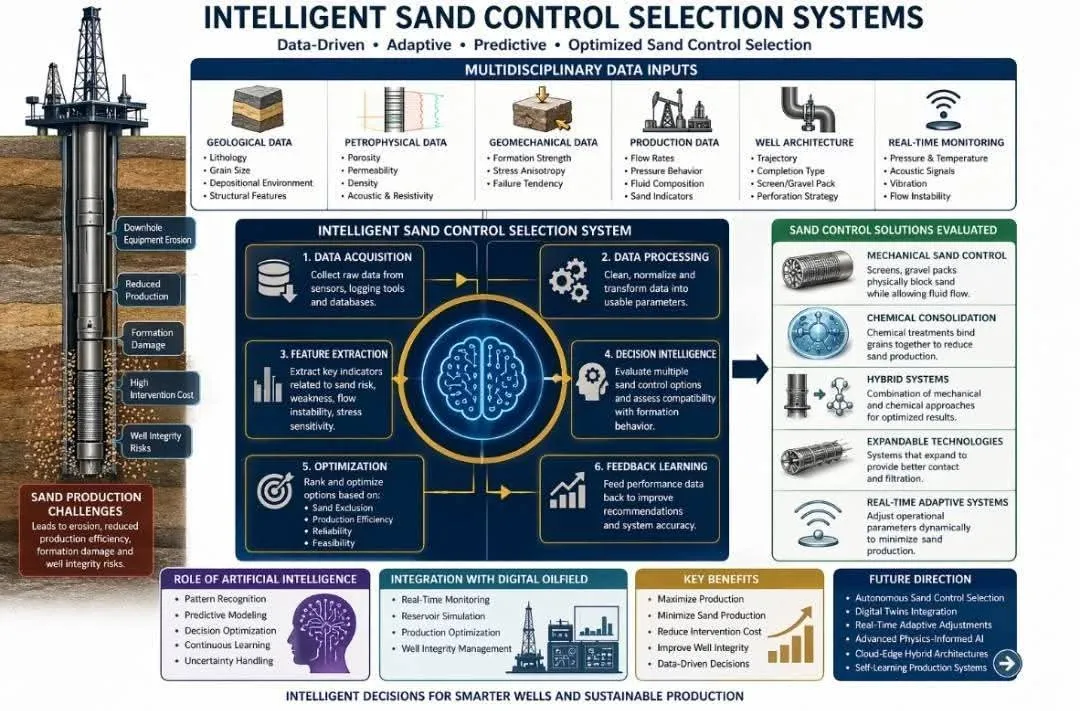
Sand production is one of the most persistent operational challenges in petroleum production systems, especially in weakly consolidated sandstone reservoirs. It leads to erosion of downhole and surface equipment, reduction in production efficiency, formation damage, and potential well integrity risks. Traditional sand control methods were historically selected based on empirical guidelines, static reservoir descriptions, and operator experience.
However, modern reservoirs are increasingly heterogeneous, high-risk, and data-rich environments. This complexity has driven the development of Intelligent Sand Control Selection Systems (ISCSS)—advanced decision-support frameworks that integrate geological, petrophysical, mechanical, and operational data to optimize sand control strategy selection.
These systems aim to move beyond conventional rule-based selection toward adaptive, data-driven, and predictive methodologies. The goal is not only to prevent sand production but to ensure maximum productivity while minimizing intervention costs and operational risks.
2. Concept of Intelligent Sand Control Selection Systems
An Intelligent Sand Control Selection System is a structured engineering framework that combines multidisciplinary data interpretation with intelligent decision logic to determine the most suitable sand control strategy for a given well or reservoir section.
Unlike traditional approaches, ISCSS does not rely solely on fixed criteria. Instead, it continuously interprets reservoir behavior, formation characteristics, and production conditions to recommend or adapt sand control solutions.
The system typically integrates:
Reservoir characterization data
Formation strength and failure tendencies
Production flow dynamics
Completion design constraints
Real-time well performance data
Historical operational knowledge embedded in algorithms
The intelligence component may include machine learning models, rule-based expert systems, or hybrid decision architectures.
3. Key Drivers Behind Intelligent Sand Control Systems
The development of ISCSS is driven by several technical and operational challenges:
3.1 Reservoir Heterogeneity
Modern reservoirs exhibit strong variations in grain size distribution, cementation, and mechanical strength. These variations make it difficult to apply a single sand control strategy across an entire field.
3.2 Increasing Well Complexity
Horizontal and highly deviated wells expose long intervals of reservoir rock to production, increasing the likelihood of localized sand production zones.
3.3 Cost and Intervention Reduction
Sand control failures often lead to costly workovers. Intelligent systems aim to reduce trial-and-error decisions and improve first-time selection success.
3.4 Data Availability
Advancements in logging tools, real-time sensors, and digital oilfield technologies provide continuous data streams that can be leveraged for decision-making.
3.5 Production Optimization Requirements
Modern production strategies aim not only to control sand but to maximize flow efficiency while maintaining long-term well stability.
4. Data Inputs for Intelligent Sand Control Selection
The performance of any intelligent system depends strongly on the quality and diversity of input data. In sand control applications, data can be categorized as follows:
4.1 Geological Data
Lithology descriptions
Grain size distribution
Sediment depositional environment
Structural features affecting stress distribution
4.2 Petrophysical Data
Porosity trends
Permeability distribution
Formation density variation
Acoustic and resistivity responses
4.3 Geomechanical Data
Formation strength indicators
Stress anisotropy conditions
Rock failure tendencies under production drawdown
4.4 Production Data
Flow rates
Pressure behavior
Fluid composition
Sand production indicators
4.5 Well Architecture Data
Well trajectory
Completion type
Screen or gravel pack configurations
Perforation strategy
4.6 Real-Time Monitoring Data
Downhole pressure and temperature
Acoustic sand detection signals
Vibration patterns
Flow instability indicators
The integration of these datasets enables a holistic view of sand production risk and control requirements.
5. Core Architecture of Intelligent Systems
An Intelligent Sand Control Selection System generally consists of multiple interconnected layers:
5.1 Data Acquisition Layer
This layer collects raw data from logging tools, sensors, and historical databases. It ensures continuous updating of reservoir and well conditions.
5.2 Data Processing Layer
Raw data is cleaned, normalized, and transformed into usable engineering parameters. This step ensures consistency across different data sources.
5.3 Feature Extraction Layer
Key indicators related to sand production risk are extracted. These may include formation weakness indicators, flow instability signatures, and stress-sensitive zones.
5.4 Decision Intelligence Layer
This is the core of the system. It evaluates multiple sand control options such as:
Gravel packing systems
Sand screens
Expandable screens
Chemical consolidation methods
Hybrid systems
The system evaluates compatibility between formation behavior and control strategy.
5.5 Optimization Layer
This layer ranks and optimizes sand control options based on performance objectives such as:
Sand exclusion efficiency
Production efficiency
Long-term reliability
Operational feasibility
5.6 Feedback Layer
Post-deployment performance data is fed back into the system to improve future recommendations.
6. Sand Control Selection Logic in Intelligent Systems
The selection logic in ISCSS is fundamentally different from traditional methods. It is not linear but adaptive.
The system typically evaluates:
6.1 Formation Stability Behavior
It determines whether the formation tends to fail under stress, and under what production conditions instability is likely.
6.2 Sand Mobilization Risk
It estimates the likelihood of particle detachment and transport into the wellbore.
6.3 Flow Regime Compatibility
Different sand control systems perform differently under varying flow regimes such as single-phase or multiphase flow.
6.4 Completion Compatibility
The system ensures that selected solutions are compatible with existing well architecture and operational constraints.
6.5 Long-Term Performance Prediction
Instead of short-term success, the system evaluates how the sand control method will behave over the entire production lifecycle.
7. Types of Sand Control Solutions Evaluated
An intelligent system typically considers a range of technical solutions:
7.1 Mechanical Sand Control
These include screens and gravel packs that physically block sand movement while allowing fluid flow.
7.2 Chemical Sand Consolidation
Chemical treatments bind formation grains together to reduce sand production risk.
7.3 Hybrid Systems
Combination of mechanical and chemical approaches to optimize performance.
7.4 Expandable Technologies
Advanced systems that expand in the wellbore to provide better contact and filtration.
7.5 Real-Time Adaptive Systems
Emerging technologies that adjust operational parameters dynamically to minimize sand production.
Each option is evaluated against formation behavior and operational constraints.
8. Role of Artificial Intelligence in Sand Control Selection
Artificial intelligence plays a critical role in modern ISCSS frameworks.
8.1 Pattern Recognition
AI models identify hidden relationships between formation properties and sand production behavior.
8.2 Predictive Modeling
Machine learning models forecast sand production likelihood under different operational scenarios.
8.3 Decision Optimization
AI systems compare multiple sand control strategies and recommend the most efficient option.
8.4 Continuous Learning
Systems improve over time by learning from historical performance data.
8.5 Uncertainty Handling
AI systems can evaluate incomplete or uncertain datasets and still produce reliable recommendations.
9. Integration with Digital Oilfield Systems
Intelligent Sand Control Selection Systems are often part of broader digital oilfield architectures.
They integrate with:
Real-time monitoring systems
Reservoir simulation platforms
Production optimization systems
Well integrity management systems
This integration allows cross-functional optimization where sand control decisions are aligned with reservoir and production strategies.
10. Challenges in Implementation
Despite their advantages, several challenges exist:
10.1 Data Quality Issues
Incomplete or noisy data can reduce system accuracy.
10.2 Model Generalization
Systems developed for one reservoir type may not perform well in others.
10.3 Computational Complexity
Large-scale data integration requires significant processing power.
10.4 Operational Trust
Engineers may hesitate to rely fully on automated recommendations.
10.5 Real-Time Constraints
Processing and decision-making must often occur under strict time limitations.
11. Future Development Directions
The evolution of ISCSS is expected to move toward:
Fully autonomous sand control selection systems
Integration with digital twins of wells and reservoirs
Real-time adaptive sand control adjustments
Advanced physics-informed AI models
Cloud-edge hybrid decision architectures
Self-learning reservoir production systems
These advancements will further reduce uncertainty and improve production efficiency.
Conclusion
Intelligent Sand Control Selection Systems represent a major transformation in petroleum production engineering. By integrating geological, petrophysical, mechanical, and real-time operational data, these systems provide a more accurate and adaptive approach to managing sand production risks.
Unlike traditional static methods, intelligent systems continuously evolve, learning from new data and improving decision quality over time. They enhance production efficiency, reduce operational risk, and support long-term well integrity.
As oil and gas fields become more complex and data-driven, the role of intelligent sand control systems will expand from decision-support tools to fully autonomous optimization platforms, shaping the future of smart reservoir and production management.
Written by Dr.Nabil Sameh
-Business Development Manager (BDM) at Nileco Company
-Certified International Petroleum Trainer
-Professor in multiple training consulting companies & academies, including Enviro Oil, ZAD Academy, and Deep Horizon , Etc.
-Lecturer at universities inside and outside Egypt
-Contributor of petroleum sector articles for Petrocraft and Petrotoday magazines, Etc.
البوم الصور
اترك تعليقًا
آخر المقالات



اشترك في النشرة الإخبارية
احصل على آخر الأخبار في صندوق البريد الوارد الخاص بك

اشترك في النشرة الإخبارية
الأكثر مشاهدة
عرب

نماذج مشرفة

فن

أخبار مصر

المؤشرات

-
- سياسة
- أعمال
- إقتصاد
- العالم
- رياضة
- صحة
- علوم
- منوعات
- المعرض
- الصور
- الفيديو
- أزياء
- أخبار مصر
- محافظات
- مقالات
- فن
- عاجل
- حوادث
- مطبخ
- مرأة
- ثقافة
- ديني
- تعليم
- عرب
- جامعات
- طقس
- اشعار وخواطر
- بنوك
- برقيات
- شركات
- سيارات
- أدب
- أسواق
- أخبار
- حوار
- أحزاب
- نماذج مشرفة
- تقارير وتحقيقات
- قضايا
- تصريح
- العملات
- صناديق المؤشرات
- الاسهم
- العملات الرقمية
- شهادات
- السندات
- صناديق
- المؤشرات
- السلع
- التضخم
- تحليل أخبارية
- إتصل بنا
التعليقات الأخيرة