
أخبار عاجلة
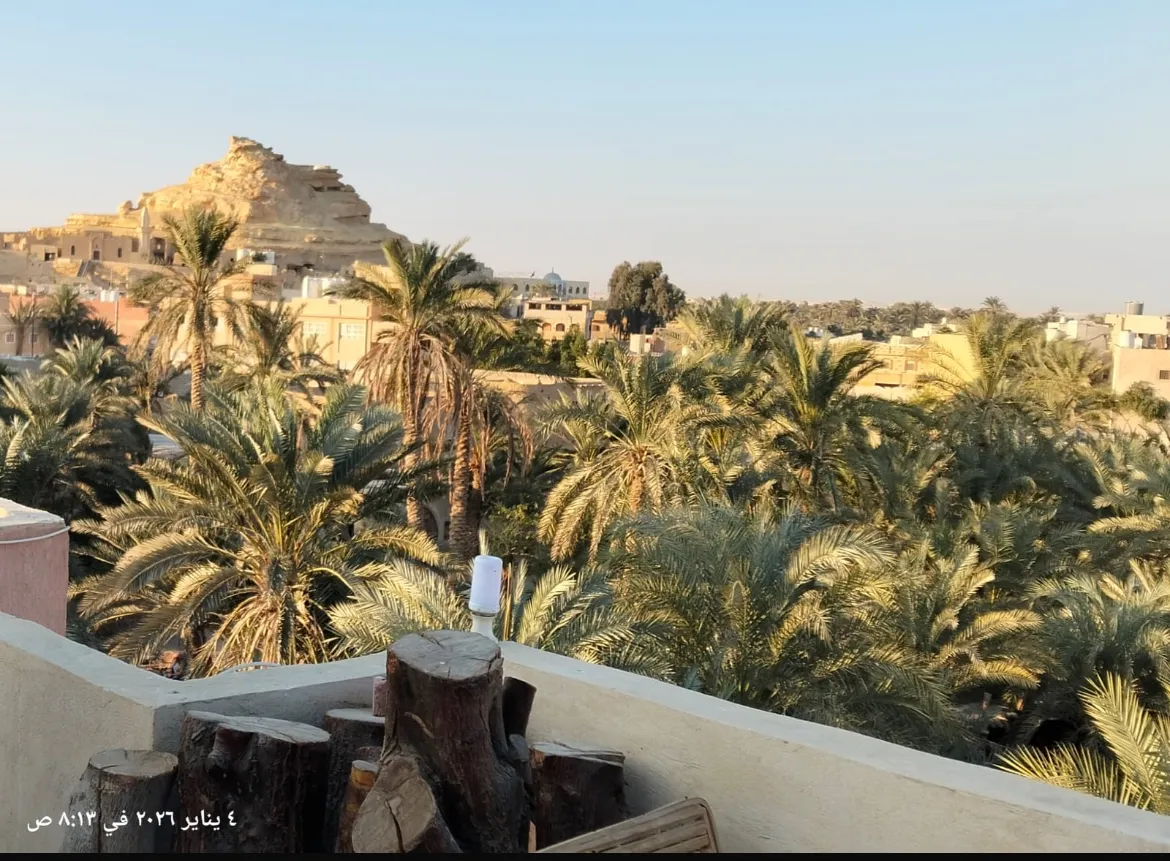
Media Figure Dr. Magdy Kamel El-Hewary Writes: «Siwa» Under the Grip of Water Chaos… Who Governs Matrouh’s Water? The Ministry of Irrigation or the City Council?
Media Figure Dr. Magdy Kamel El-Hewary Writes: «Siwa» Under the Grip of Water Chaos… Who Governs Matrouh’s Water? The Ministry of Irrigation or the City Council?
At a time when Egypt’s Ministry of Water Resources and Irrigation is leading one of the most critical and sensitive portfolios in the country — under the leadership of internationally renowned expert Dr. Hani Sewilam, who assumed office in August 2022 and whose mandate has recently been renewed, recognized as one of the world’s leading specialists in water management and sustainable development — the reality on the ground in Siwa Oasis, Matrouh Governorate, appears entirely inconsistent with what is officially declared.
While the state speaks of rationalizing water consumption, modernizing irrigation systems, and achieving equitable water distribution, what we witness in Siwa resembles administrative disorder, absence of decisive leadership, and the handing over of water distribution to parties that hold neither legal jurisdiction nor institutional affiliation with the Ministry.
Thirsty Land… and an Official Who Steps Aside
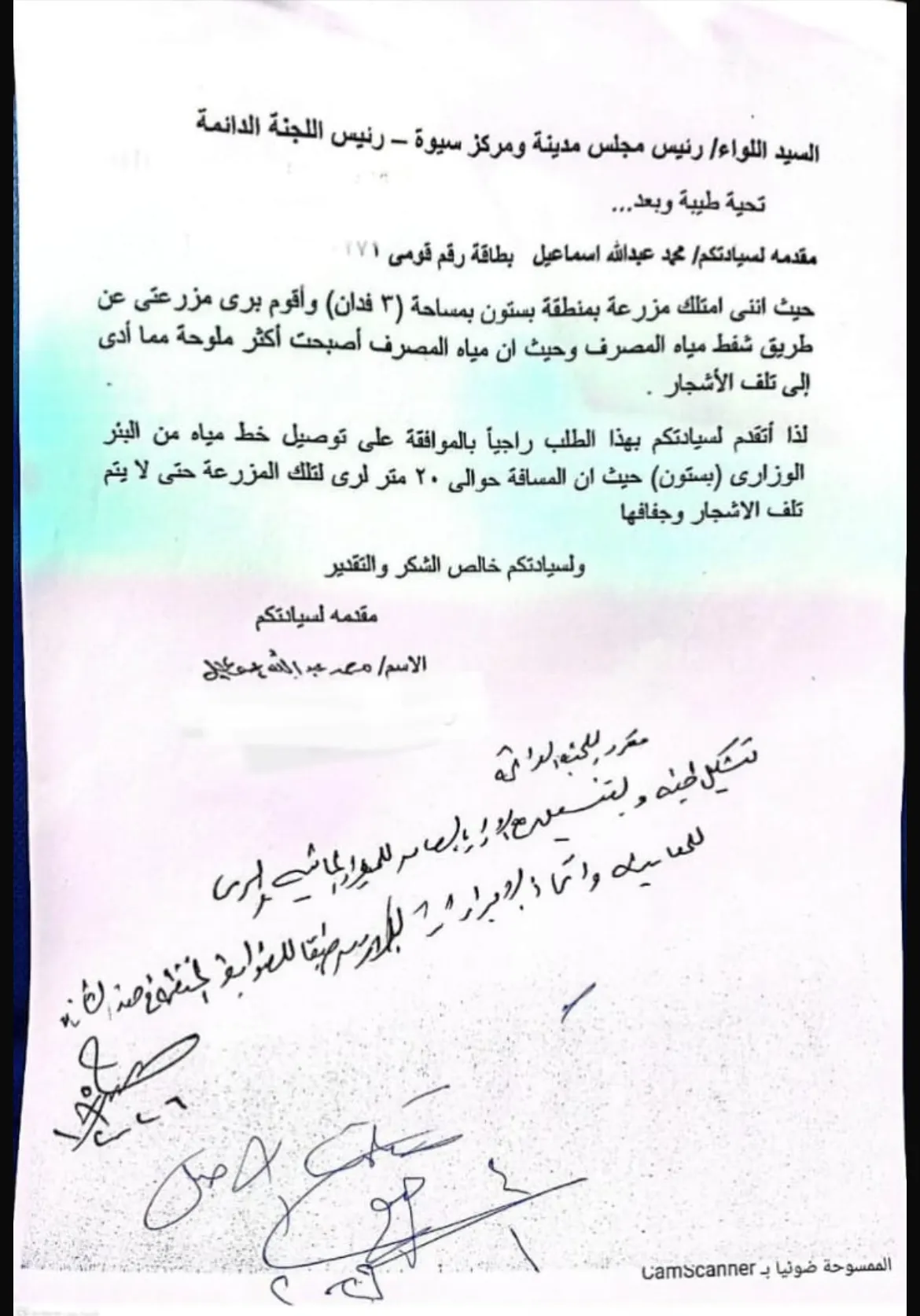
A citizen (M.A.A.) in Siwa Oasis, who owns three feddans cultivated with palm and olive trees, was shocked to find irrigation water cut off from his land due to what he described as arbitrary diversions. He submitted a formal request to Eng. Emad El-Shamy, Undersecretary of the Ministry of Water Resources and Irrigation.
However, according to his account, the request was not even formally received. Instead, he was redirected to the Head of Siwa City Council on the grounds that the matter did not concern the Irrigation Undersecretary.
Here, the most serious question begins.
A Direct Constitutional Question:
Who Holds Jurisdiction?
What authority does Siwa City Council — affiliated with the Ministry of Local Development — have over the affairs and operations of the Directorate of the Ministry of Water Resources and Irrigation?
How can a purely technical matter — concerning wells, irrigation networks, and water distribution — be transferred from the legally competent authority (the Ministry of Irrigation) to a local administrative body that lacks both the technical and legal mandate in this domain?
Why does the former control decisions that belong to the latter?
If the Ministry of Irrigation holds technical jurisdiction over water resources, how does decision-making shift to the City Council?
If the City Council directs and decides, then what is the role of the Irrigation Directorate?
And ultimately — who holds whom accountable?
This overlap of authorities is not merely an administrative irregularity; it opens a dangerous door to blurred responsibilities and the absence of accountability.
A Paralyzed Committee… and Dying Lands
The Head of the City Council referred the request to the Chairman of the Permanent Committee for decision.
But according to available information, the Committee Chairman was injured in an accident, has a broken leg, is over sixty-five years old, does not leave his home, and files are piling up without signature or resolution.
What kind of administrative disorder is this?
Should citizens’ livelihoods come to a halt because one individual is physically unable to act?
Where is the delegation system?
Where is the alternative mechanism?
Where is the institutional state we speak of?
An Engineering Paradox Raising Serious Questions
The well in question lies only 18 meters from the citizen’s land.
Yet he is compelled to extend a 220-meter pipeline from a mixed reservoir to irrigate his field.
A decision that multiplies costs and wastes time — without any convincing technical justification.
When the citizen offered to bear the cost of constructing a mixed reservoir inside his own land to reduce expenses, he was told that the request was “unconvincing,” and that the decision remains suspended due to the Committee Chairman’s injury.
Meanwhile, according to eyewitness accounts, the very same well supplies fresh irrigation connections to other reservoirs — reportedly facilitated through personal relationships, mediation, and favoritism.
If this is accurate, then this is no longer a technical issue… but a serious administrative imbalance.
A Ready-Made Response… and a Puzzling Characterization
When the citizen escalated his complaint to the Minister of Water Resources and Irrigation, Dr. Hani Sewilam, a response came swiftly.
However, according to the account, the reply appeared pre-prepared by officials in Matrouh, stating that the citizen “wants fresh water.”
One must ask: what would he do with it on agricultural land?
The land is planted with palm and olive trees. The farmer merely requested irrigation through the construction of a mixed reservoir within his property — yet the matter was framed as though he were demanding a special privilege.
Even when citizens requested that the Minister form a neutral fact-finding committee to investigate the complaint and verify its accuracy, no such committee has been formed to date.
Has requesting irrigation now become an accusation?
Who is responsible for the dying crops in Siwa?
Palm and olive trees in Siwa are not merely crops — they are identity, a tourism symbol, and an economic resource.
Who bears responsibility for the destruction of these high-value plantations?
Who is accountable, Mr. Prime Minister, for the loss and devastation of Siwa’s agricultural and tourism-linked crops?
(A Final Message That Cannot Be Delayed)
The injustice in irrigation water distribution continues in Siwa, Mr. President Abdel Fattah El-Sisi.
The injustice in irrigation water distribution still persists, Mr. Prime Minister.
If water management is a matter of national security, then leaving it hostage to overlapping jurisdictions, arbitrary decisions, local favoritism, and committee decision-makers with no technical or legal affiliation to the Ministry of Water Resources and Irrigation constitutes a danger no less serious than water scarcity itself.
Today, Siwa is not merely asking for water.
It is asking:
Who governs?
Who decides?
Who holds the authority to hold others accountable?
And who assigns critical files to those neither technically nor legally qualified to handle them?
البوم الصور
اترك تعليقًا

آخر المقالات


اشترك في النشرة الإخبارية
احصل على آخر الأخبار في صندوق البريد الوارد الخاص بك

اشترك في النشرة الإخبارية
الأكثر مشاهدة
عرب

نماذج مشرفة

فن
أخبار مصر
المؤشرات

-
- سياسة
- أعمال
- إقتصاد
- العالم
- رياضة
- صحة
- علوم
- منوعات
- المعرض
- الصور
- الفيديو
- أزياء
- أخبار مصر
- محافظات
- مقالات
- فن
- عاجل
- حوادث
- مطبخ
- مرأة
- ثقافة
- ديني
- تعليم
- عرب
- جامعات
- طقس
- اشعار وخواطر
- بنوك
- برقيات
- شركات
- سيارات
- أدب
- أسواق
- أخبار
- حوار
- أحزاب
- نماذج مشرفة
- تقارير وتحقيقات
- قضايا
- تصريح
- العملات
- صناديق المؤشرات
- الاسهم
- العملات الرقمية
- شهادات
- السندات
- صناديق
- المؤشرات
- السلع
- التضخم
- تحليل أخبارية
- إتصل بنا
التعليقات الأخيرة