
أخبار عاجلة

Machine Learning for Leak Detection in Subsea Pipelines Written by Dr.Nabil Sameh
1. Introduction to Subsea Pipeline Systems
Subsea pipelines are a fundamental part of offshore oil and gas production networks. They are responsible for transporting hydrocarbons from seabed wells to offshore platforms or onshore facilities. These pipelines operate under extreme environmental conditions, including high hydrostatic pressure, low temperatures, and corrosive seawater exposure.
Ensuring the integrity of subsea pipelines is a critical engineering priority because any failure can lead to operational disruptions, environmental damage, and significant economic losses. Leak detection, therefore, is not only a technical requirement but also a strategic necessity for sustainable offshore operations.
Traditional monitoring methods depend on manual inspections and basic sensor readings. However, as offshore fields become more complex and deeper, these methods are no longer sufficient. This has led to the adoption of advanced digital technologies, particularly Machine Learning (ML), which enables intelligent and automated leak detection.
2. Challenges of Leak Detection in Subsea Environments
Detecting leaks in subsea pipelines is significantly more difficult than in onshore systems due to several environmental and operational constraints.
One of the primary challenges is inaccessibility. Subsea pipelines are located at great depths, making direct inspection extremely difficult and costly. This limits the ability to physically verify pipeline conditions in real time.
Another challenge is harsh environmental interference. Ocean currents, temperature variations, and pressure fluctuations affect sensor readings and introduce noise into collected data. This makes it difficult to distinguish between normal operational changes and actual leak signals.
Data transmission is also a limiting factor. Communication between subsea equipment and surface control systems often experiences delays or bandwidth limitations, reducing the effectiveness of real-time monitoring.
In addition, the complexity of multiphase flow inside pipelines creates unpredictable behavior. Gas, oil, and water mixtures can behave differently under varying conditions, complicating leak identification using conventional methods.
3. Conventional Leak Detection Methods
Before the introduction of intelligent systems, leak detection relied on traditional engineering approaches.
These methods include pressure monitoring, where abnormal pressure drops may indicate leakage. Flow balance techniques are also used, comparing input and output flow rates to identify inconsistencies. Acoustic sensing is another method that detects sound patterns generated by escaping fluids.
Although these techniques are widely used, they have limitations. They often generate false alarms due to natural operational fluctuations. They also tend to detect leaks only after they have already developed, rather than predicting them in advance.
Moreover, traditional systems lack adaptability. They cannot easily adjust to changing operational conditions or learn from historical data, which reduces their long-term effectiveness in complex subsea environments.
4. Introduction to Machine Learning in Subsea Monitoring
Machine Learning introduces a new approach to leak detection by enabling systems to learn from data rather than relying solely on predefined rules.
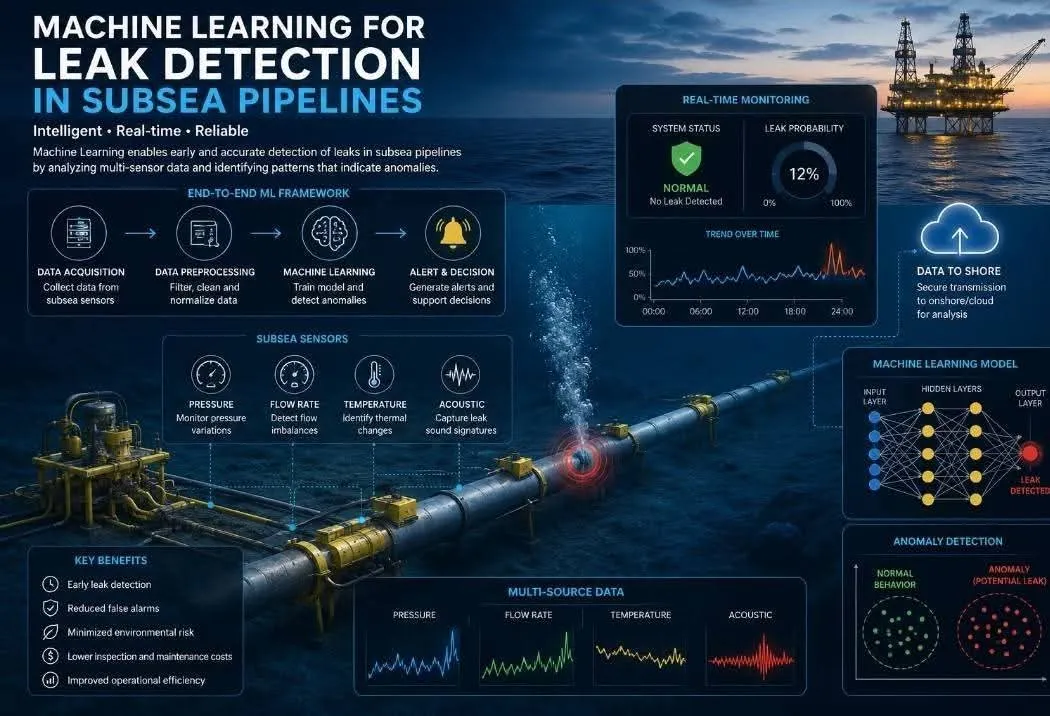
In subsea pipeline monitoring, ML models analyze large datasets collected from sensors such as pressure gauges, flow meters, temperature sensors, and acoustic devices. By processing this data, the system can identify patterns that represent normal operating behavior.
Once a baseline is established, the model can detect deviations from normal conditions. These deviations may indicate potential leaks or developing faults. Unlike traditional systems, ML-based approaches improve over time as more data becomes available.
This adaptability makes Machine Learning particularly suitable for subsea environments, where operating conditions are highly dynamic and difficult to model using conventional methods.
5. Data Sources and Feature Interpretation
The effectiveness of Machine Learning in leak detection depends heavily on the quality and diversity of input data.
Subsea pipelines generate multiple types of data continuously. Pressure data is one of the most important indicators, as sudden changes may suggest leakage or blockages. Flow rate data helps in identifying imbalances within the pipeline system.
Temperature data also provides valuable insights, especially in deepwater conditions where thermal variations can influence fluid behavior. Acoustic signals are another important data source, as leaks often produce distinct sound patterns when fluids escape under pressure.
Machine Learning systems process these inputs collectively rather than individually. By combining multiple data streams, the model gains a more comprehensive understanding of pipeline behavior, improving detection accuracy and reducing false alarms.
6. Machine Learning Approaches for Leak Detection
Several Machine Learning approaches can be applied to subsea leak detection, depending on the type and availability of data.
Supervised learning models are used when historical labeled data is available. These models learn to classify conditions as normal or abnormal based on previous examples.
Unsupervised learning methods are more common in subsea applications because labeled leak data is often limited. These models focus on identifying anomalies without prior knowledge of leak events.
Another important approach is anomaly detection, where the system continuously monitors deviations from normal operational patterns. This is particularly useful in real-time monitoring systems.
Deep learning techniques are also increasingly used for complex pattern recognition, especially when dealing with high-dimensional sensor data and time-dependent variations.
7. System Architecture of ML-Based Leak Detection
A Machine Learning-based leak detection system typically consists of several integrated components.
The first component is the data acquisition layer, which collects real-time information from subsea sensors. This data is transmitted to surface processing units or cloud-based platforms.
The second component is data preprocessing, where raw data is cleaned, filtered, and organized to remove noise and inconsistencies. This step is essential for ensuring model accuracy.
The third component is the Machine Learning model itself, which processes the prepared data and identifies patterns or anomalies.
The final component is the decision support system, which interprets model outputs and provides alerts or recommendations to operators. This system plays a critical role in operational decision-making and risk management.
8. Advantages of Machine Learning in Leak Detection
Machine Learning offers several important advantages in subsea pipeline monitoring.
One of the main benefits is early detection capability. ML models can identify subtle changes in system behavior before a full leak occurs, allowing for preventive action.
Another advantage is reduced false alarms. By learning normal operational patterns, the system can better distinguish between real leaks and harmless fluctuations.
Machine Learning also improves operational efficiency by enabling continuous monitoring without the need for manual intervention.
Additionally, ML systems are highly scalable and can be applied across multiple pipeline networks, making them suitable for large offshore operations.
9. Limitations and Implementation Challenges
Despite its advantages, Machine Learning implementation in subsea systems faces several challenges.
One major limitation is data quality. Inaccurate or incomplete sensor data can significantly reduce model performance.
Another challenge is computational complexity. Advanced ML models require significant processing power, which may be limited in offshore environments.
Model interpretability is also an issue. Some advanced algorithms function as "black boxes," making it difficult for engineers to understand how decisions are made.
Furthermore, system integration with existing offshore infrastructure can be complex and requires careful engineering design.
10. Future Trends in Intelligent Subsea Monitoring
The future of leak detection in subsea pipelines is expected to be increasingly digital and autonomous.
Integration of Artificial Intelligence with Internet of Things (IoT) technologies will enable more connected and intelligent subsea systems. Real-time analytics will become more advanced, allowing for immediate response to potential failures.
Edge computing is also expected to play a major role, enabling data processing closer to the source and reducing transmission delays.
Furthermore, hybrid models combining physics-based simulations with Machine Learning are likely to enhance accuracy and reliability in complex subsea environments.
Conclusion
Machine Learning represents a significant advancement in the field of subsea pipeline leak detection. By moving beyond traditional rule-based systems, it introduces intelligent, adaptive, and predictive capabilities that are essential for modern offshore operations.
Although challenges such as data quality, system complexity, and integration remain, the benefits of improved safety, early detection, and operational efficiency make Machine Learning a powerful tool in subsea engineering.
As offshore developments continue to expand into deeper and more complex environments, the role of Machine Learning will become increasingly central in ensuring the integrity and sustainability of subsea pipeline systems.
Written by Dr.Nabil Sameh
-Business Development Manager (BDM) at Nileco Company
-Certified International Petroleum Trainer
-Professor in multiple training consulting companies & academies, including Enviro Oil, ZAD Academy, and Deep Horizon , Etc.
-Lecturer at universities inside and outside Egypt
-Contributor of petroleum sector articles for Petrocraft and Petrotoday magazines, Etc.
البوم الصور
اترك تعليقًا

آخر المقالات



اشترك في النشرة الإخبارية
احصل على آخر الأخبار في صندوق البريد الوارد الخاص بك

اشترك في النشرة الإخبارية
الأكثر مشاهدة
عرب

نماذج مشرفة

فن

أخبار مصر

المؤشرات

-
- سياسة
- أعمال
- إقتصاد
- العالم
- رياضة
- صحة
- علوم
- منوعات
- المعرض
- الصور
- الفيديو
- أزياء
- أخبار مصر
- محافظات
- مقالات
- فن
- عاجل
- حوادث
- مطبخ
- مرأة
- ثقافة
- ديني
- تعليم
- عرب
- جامعات
- طقس
- اشعار وخواطر
- بنوك
- برقيات
- شركات
- سيارات
- أدب
- أسواق
- أخبار
- حوار
- أحزاب
- نماذج مشرفة
- تقارير وتحقيقات
- قضايا
- تصريح
- العملات
- صناديق المؤشرات
- الاسهم
- العملات الرقمية
- شهادات
- السندات
- صناديق
- المؤشرات
- السلع
- التضخم
- تحليل أخبارية
- إتصل بنا
التعليقات الأخيرة